
Choosing the right welding gloves is essential for anyone working around intense heat, sparks, molten metal spatter, sharp edges, and abrasive materials. Whether you are performing TIG, MIG, or Stick welding, your hands require protection designed specifically for the hazards and precision demands of the process.
At Noorsons Safety, we understand that professional welders need more than a thick pair of leather gloves. The best welding safety gloves must combine heat resistance, dexterity, durability, comfort, and reliable hand coverage without unnecessarily restricting movement.
From lightweight TIG welding gloves designed for precise torch control to heavy-duty Stick welding gloves built for demanding heat and spatter exposure, selecting the correct glove can improve both worker protection and job performance.
This complete welding glove guide explains how to choose the best welding gloves according to welding process, leather type, heat exposure, glove construction, lining, fit, and industrial working conditions.
Why Choosing the Right Welding Gloves Matters
Professional welding places the hands close to some of the most demanding hazards found in metalworking environments. Welders may encounter radiant heat, sparks, hot metal, molten spatter, sharp components, rough steel surfaces, and repetitive mechanical wear during a single task.
This makes welding hand protection fundamentally different from ordinary work gloves.
A glove that is too bulky may interfere with torch control, trigger operation, and filler-rod handling. A glove that is too lightweight may not provide sufficient protection against higher levels of heat and welding spatter.
High-quality industrial welding gloves should therefore provide an application-specific balance of heat resistance, abrasion resistance, hand mobility, durable construction, secure fit, and wrist or forearm coverage.
The right combination depends largely on whether the worker is performing TIG welding, MIG welding, Stick welding, fabrication, metalworking, or multi-process welding.
TIG vs. MIG vs. Stick Welding Gloves: What Is the Difference?
One of the most important factors when choosing welding gloves is understanding that every welding process places different demands on the hands.
TIG requires exceptional dexterity. MIG combines heat exposure with the need for trigger control. Stick welding generally requires heavier protection against heat, sparks, and spatter.
Selecting welding gloves by application is therefore more effective than treating all welding gloves as interchangeable PPE.
TIG Welding Gloves – Maximum Dexterity for Precision Work
TIG welding gloves, also known as gloves for Gas Tungsten Arc Welding (GTAW), are designed primarily around dexterity and tactile control.
TIG welders need precise finger movement to manipulate the torch and continuously control filler material. Excessively thick gloves can interfere with this process.
For this reason, professional TIG gloves frequently use flexible leathers such as goatskin or deerskin.
Quality TIG welding gloves should provide excellent finger mobility, tactile feedback, comfortable thumb movement, appropriate wrist coverage, durable stitching, and sufficient heat resistance for the intended application.
Goatskin TIG gloves are particularly popular because the material provides a useful combination of flexibility and mechanical strength without excessive bulk.
For professionals searching for the best gloves for TIG welding, dexterity should be considered alongside heat exposure rather than simply choosing the thickest available glove.
TIG welding gloves are commonly used for precision fabrication involving stainless steel, aluminum, copper, nickel alloys, and other applications requiring controlled hand movement.
MIG Welding Gloves – Heat Resistance Meets Working Control
MIG welding gloves must handle a different combination of hazards.
Metal Inert Gas welding can generate greater heat, sparks, and spatter than TIG welding. This means MIG gloves generally require more substantial thermal protection while still allowing comfortable control of the welding gun and trigger.
Quality leather MIG welding gloves commonly use cowhide or other durable leather constructions together with protective linings, reinforced sections, extended cuffs, and heat-resistant seams.
The ideal MIG welding glove should balance:
- Heat and spatter protection
- Trigger and tool control
- Abrasion resistance
- Reinforced high-wear areas
- Comfortable long-duration wear
Professional MIG gloves are widely used across structural steel fabrication, automotive manufacturing, workshops, construction, pipeline work, general fabrication, and industrial metalworking.
For welders and industrial buyers searching for heat resistant welding gloves for MIG welding, both insulation and mobility should be evaluated before making a final selection.
Stick Welding Gloves – Heavy-Duty Protection for Demanding Work
Stick welding gloves are designed for environments where higher levels of heat, sparks, and molten spatter may be present.
Also known as SMAW welding, Stick welding commonly requires heavier glove construction than precision TIG work.
Heavy-duty leather welding gloves manufactured from split cowhide or similarly rugged materials are frequently used because they provide the durability and thermal performance needed for demanding applications.
Professional Stick welding gloves may incorporate thermal linings, reinforced palms, protected seams, heat-resistant stitching, leather overlays, and extended gauntlet cuffs.
These heavy-duty welding gloves are commonly used in structural fabrication, construction, shipbuilding, mining, repair work, pipelines, steel erection, and other challenging industrial environments.
When selecting gloves for Stick welding, prioritize the level of protection required by the actual task rather than maximum dexterity alone.
Can You Use the Same Gloves for TIG, MIG and Stick Welding?
Multi-purpose welding gloves can be suitable for certain mixed-process environments, but one glove should not automatically be considered appropriate for every welding operation.
A heavier MIG glove may sometimes be suitable for certain TIG tasks, although additional thickness can reduce tactile control. Lightweight TIG gloves, on the other hand, should not automatically be used for high-spatter MIG or Stick welding.
The safest approach is to select welding PPE according to the highest thermal, mechanical, and spatter hazards expected during the task.
For industrial facilities performing several welding processes, maintaining process-specific hand protection can also help workers select appropriate PPE more consistently.
How to Choose the Best Welding Gloves
Finding the best welding gloves for professional welders requires more than comparing appearance or leather thickness.
Start with a workplace hazard assessment and consider the welding process, expected temperature exposure, spatter levels, materials being handled, sharp-edge hazards, abrasion, environmental conditions, and required finger movement.
These factors help determine the appropriate combination of leather, lining, reinforcement, cuff design, and overall glove construction.
Heat-Resistant Welding Gloves
Heat protection is one of the most important characteristics of welding PPE.
Depending on the process, hands may be exposed to radiant heat, hot components, sparks, and molten welding spatter. Heat-resistant welding gloves should therefore be selected according to the intensity and duration of expected exposure.
More insulation is not always automatically better. Excessive insulation can reduce dexterity and increase hand fatigue where precision is required.
The objective is to achieve the correct level of thermal performance while preserving the mobility required for the job.
Cut and Abrasion Resistance
Welding often involves much more than operating a torch.
Workers may position sheet metal, handle fabricated components, move steel parts, use wire, remove slag, or work around sharp edges and rough surfaces.
Where these hazards exist, cut-resistant welding gloves or suitable protective liners may provide additional hand protection.
Abrasion resistance is equally important. Repeated contact with rough steel can gradually damage leather, stitching, and seams. Industrial buyers should therefore inspect high-wear areas and reinforcement rather than focusing solely on glove thickness.
Choosing the Best Leather for Welding Gloves
Leather remains one of the most established materials for professional welding gloves because it can provide heat resistance, mechanical durability, flexibility, and abrasion resistance.
However, different leather types offer different advantages.
Cowhide Welding Gloves
Cowhide welding gloves are among the most versatile choices for professional welding.
Cowhide provides a strong combination of durability, abrasion resistance, thermal performance, and value. Depending on thickness and construction, it is particularly suitable for MIG welding, Stick welding, metal fabrication, and general industrial welding.
For applications involving regular contact with rough materials and demanding working conditions, cowhide offers dependable performance.
Goatskin Welding Gloves
Goatskin welding gloves are valued for their flexibility, strength-to-weight characteristics, and tactile feel.
Because goatskin can provide good mechanical strength without excessive thickness, it is particularly useful for TIG welding and other precision applications.
Workers who require accurate finger movement and controlled torch handling may benefit from lightweight goatskin glove construction where the thermal hazards are appropriate.
Deerskin Welding Gloves
Deerskin offers a naturally soft and flexible feel, allowing gloves to conform comfortably to the hand.
This makes deerskin welding gloves useful for applications where dexterity and prolonged comfort are priorities. Properly designed deerskin gloves can be particularly effective for precision fabrication and TIG welding.
Elkskin Welding Gloves
Elkskin combines durability with a naturally comfortable feel. It can provide a useful balance between toughness and flexibility for demanding welding and fabrication work.
For professional welders requiring more substantial hand protection without unnecessarily sacrificing mobility, well-constructed elkskin gloves can be a strong option.
Full-Grain vs. Split-Leather Welding Gloves
The part of the hide used in glove construction can significantly influence performance.
Full-grain leather welding gloves typically offer strong abrasion resistance, flexibility, and durability. Depending on treatment and finish, full-grain leather may also provide useful resistance to moisture and oils.
Split-leather welding gloves use material from the lower layers of the hide and are widely used for high-heat and rugged welding applications.
Split cowhide is particularly common in MIG and Stick welding gloves because it provides robust performance for demanding industrial environments.
Neither type is universally superior. The best choice depends on heat exposure, required dexterity, welding process, glove construction, and workplace hazards.
Welding Glove Construction: Details That Make a Difference
Material selection is only part of what determines glove performance.
The construction of professional welding gloves can have a significant impact on comfort, durability, and working life.
Gunn Cut and Clute Cut
A Gunn cut can position seams away from major palm wear areas, helping improve comfort and durability during repeated handling.
A Clute cut generally uses a one-piece palm with separate sections on the back of the fingers, creating a different fit and flexibility profile.
Glove construction should be selected according to the required combination of grip, movement, and durability.
Thumb Construction
Thumb design can directly affect how naturally a worker grips welding equipment and materials.
Wing-thumb construction can provide a more natural gripping angle and freedom of movement, while straight-thumb construction provides a traditional design suitable for many general welding and handling applications.
Reinforced Welding Gloves for Industrial Use
Industrial welding gloves should be built to withstand more than occasional heat exposure.
Reinforced palms, thumb patches, back-of-hand overlays, leather gores, protected seams, and durable cuffs can extend glove life in high-wear environments.
Heat-Resistant Stitching
Para-aramid and other suitable heat-resistant threads can improve seam durability in applications involving heat, sparks, and abrasion.
Welted Seams
Welted seams use additional material around vulnerable seam areas to help shield stitching from sparks and mechanical wear.
Gauntlet Welding Gloves
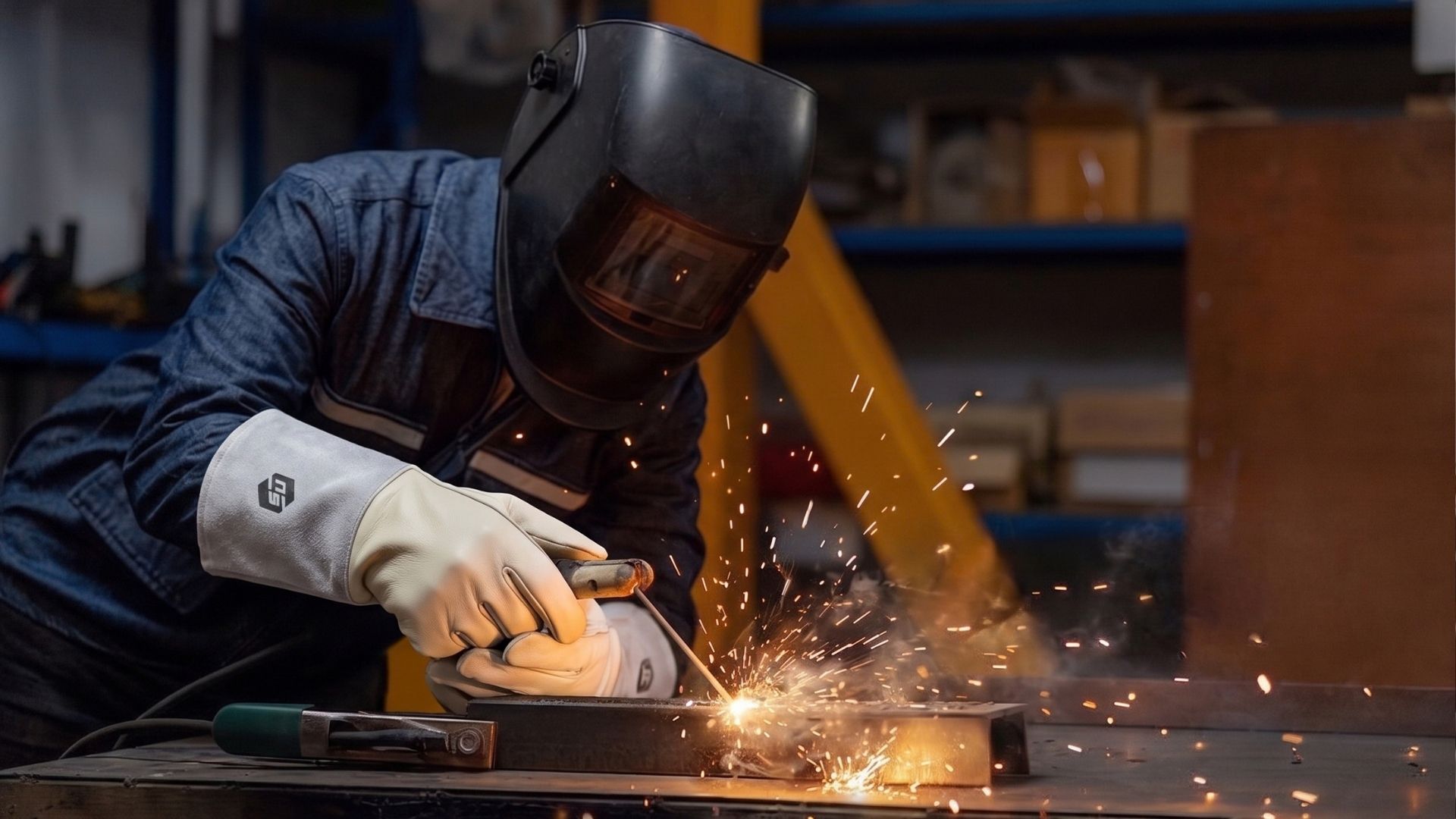
Gauntlet welding gloves feature extended cuffs that provide additional wrist and lower-forearm coverage.
They are particularly useful where sparks and spatter could otherwise reach exposed areas between the glove and protective clothing.
Cuff selection should always consider compatibility with welding jackets, sleeves, and other PPE.
Welding Glove Linings and Insulation
Glove linings influence heat management, comfort, cut resistance, and overall thickness.
Cotton and fleece linings can provide comfortable insulation for moderate thermal conditions. Foam layers can add cushioning and thermal resistance, while para-aramid liners may provide additional cut and thermal performance for demanding applications.
When selecting insulated welding gloves, buyers should avoid unnecessary bulk that could interfere with tool control and natural finger movement.
The best lining is the one that provides the required level of protection for the actual application while maintaining usable dexterity.
Why Proper Welding Glove Fit Matters
Even high-quality welding gloves can perform poorly when the fit is incorrect.
Oversized gloves can reduce tactile feedback, interfere with grip, and make precise tool control more difficult. Gloves that are too tight can restrict finger movement, create pressure points, and contribute to hand fatigue.
A properly fitted welding work glove should allow natural finger movement while remaining secure around the palm and wrist.
Correct sizing becomes especially important for TIG welding and other precision fabrication tasks where controlled hand movement directly influences working accuracy.
Welding Glove Selection Checklist
Before selecting welding gloves for professional or industrial use, consider these five factors:
- Identify the welding process: Determine whether the application involves TIG, MIG, Stick, or multiple welding processes.
- Evaluate workplace hazards: Assess radiant heat, conductive heat, sparks, molten spatter, sharp edges, abrasion, and environmental conditions.
- Select the appropriate leather: Consider goatskin or deerskin where dexterity is critical and cowhide, split leather, or heavier constructions for more demanding thermal environments.
- Check fit, lining, and coverage: Evaluate finger movement, cuff length, wrist protection, thermal lining, and compatibility with other PPE.
- Inspect construction quality: Look closely at seams, stitching, reinforced palms, thumb construction, high-wear areas, and overall workmanship.
Best Welding Gloves for Industrial and Professional Use
There is no single best welding glove for every worker or every process.
The best TIG welding glove may be a lightweight leather design that prioritizes tactile control. The best MIG welding glove may require additional insulation and reinforcement. The best Stick welding glove may use heavier leather and extended coverage to manage greater heat and spatter exposure.
For safety managers, distributors, procurement professionals, and industrial buyers, this means welding gloves should be evaluated according to application-specific performance rather than a one-size-fits-all approach.
Choosing the right glove can support worker comfort, consistent tool control, durability, and efficient welding operations.
Why Choose Noorsons Safety for Professional Welding Gloves?
Noorsons Safety understands the demands placed on hand protection in professional welding, metal fabrication, construction, workshops, and heavy industrial environments.
Our approach to industrial welding gloves focuses on the factors that matter in real working conditions: appropriate leather selection, practical glove construction, heat management, durability, dexterity, coverage, and long-term comfort.
Whether the application requires TIG welding gloves, MIG welding gloves, Stick welding gloves, leather welding gloves, heat-resistant gloves, or heavy-duty industrial hand protection, selecting equipment according to the job helps create a safer and more productive working environment.
Conclusion
Choosing the best welding gloves begins with understanding the welding process and the hazards surrounding it. TIG welding generally requires lightweight construction and superior dexterity, MIG welding demands a practical balance of heat protection and hand control, while Stick welding typically requires heavier protection against heat, sparks, and molten spatter.
Leather type, thermal performance, glove lining, seam construction, reinforcement, cuff length, fit, and overall durability should all be evaluated before making a final selection.
For industrial teams, the goal should not simply be to find the thickest or heaviest glove. The objective is to select the right welding glove for the process, hazard level, and working environment.
With application-focused hand protection from Noorsons Safety, professional welders, fabricators, and industrial teams can approach demanding work with greater control, comfort, and confidence. Explore our professional range of welding gloves for TIG, MIG, Stick, fabrication, and demanding industrial applications at noorsonss.com